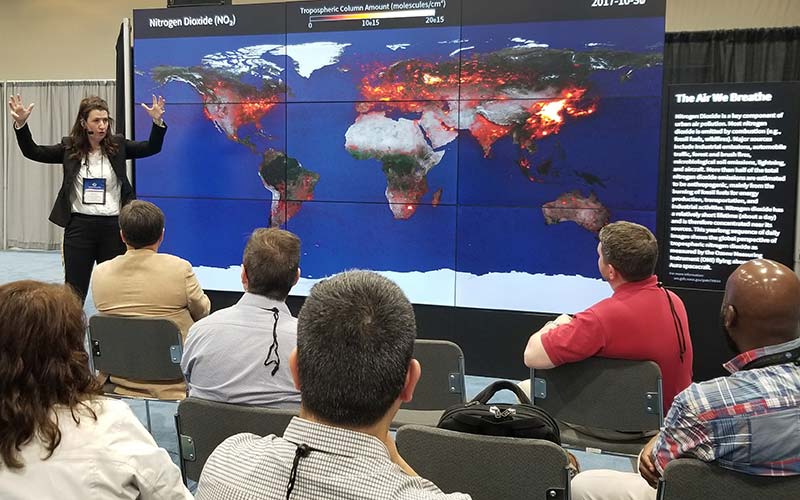


SAGE aims to improve our understanding of the global environment, and how it is being affected by human activities. To achieve this goal, we have been developing maps, computer models and datasets to describe the behavior of Earths terrestrial ecosystems, hydrological systems, and climate. We have developed a new generation of global ecosystem (IBIS) and terrestrial hydrology (THMB) models, as well as fully coupled climate-vegetation models (GENESIS-IBIS and CCM3-IBIS). In addition, we have created new datasets of global ecosystems, historical land use, and land cover change, datasets specific to the Amazon Basin.
You may freely download any of these items.
Data
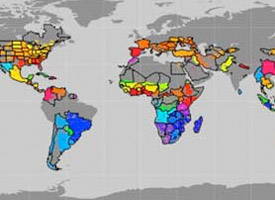
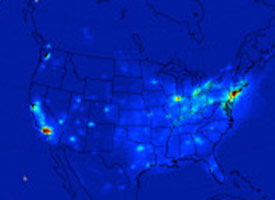
Global Maps of Urban Extent from Satellite Data (NEW!) - Although cities cover a tiny fraction (< 1% ) of the worlds surface, urban areas are the nexus of human activity with >50% of the population and 70-90% of economic activity. As such, material / energy consumption, air pollution, and expanding impervious surface are all concentrated in urban areas, with important environmental implications at local, regional and potentially global scales. New ways to measure the built environment over large areas are thus critical to answering a wide range of research questions on the role of urbanization in climate, biogeochemistry and hydrological cycles. In this ongoing research initiative, we have developed a new dataset depicting global urban land c. 2001-2002 based on Moderate Resolution Imaging Spectroradiometer (MODIS) 500-m satellite data. Our methods exploit temporal and spectral information in one year of MODIS observations, classified using an ensemble decision tree classification approach.
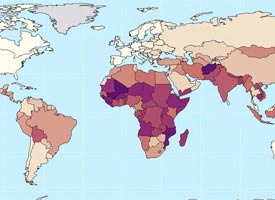
Crop Calendar Dataset - This dataset is the result of digitizing and georeferencing existing observations of crop planting and harvesting dates. We then derived climate statistics (e.g., the average temperature at which planting occurs in each region) by merging these crop calendar maps with monthly climatologies from CRU. This dataset is described in the following publication: Sacks, W.J., D. Deryng, J.A. Foley, and N. Ramankutty (in review). Crop planting dates: An analysis of global patterns. Global Ecology and Biogeography
Agricultural Lands in the Year 2000 (M3-Cropland and M3-Pasture Data) - from Ramankutty et al. (2008), "Farming the planet: 1. Geographic distribution of global agricultural lands in the year 2000", Global Biogeochemical Cycles, Vol. 22, GB1003, doi:10.1029/2007GB002952. The data is provided in two formats NetCDF and ArcINFO ASCII at 5 minute resolution in latitude by longitude. Hosted at McGill University. Please contact Navin Ramankutty with any questions.
Harvested Area and Yields of 175 crops (M3-Crops Data) - from Monfreda et al. (2008), "Farming the planet: 2. Geographic distribution of crop areas, yields, physiological types, and net primary production in the year 2000", Global Biogeochemical Cycles, Vol.22, GB1022, doi:10.1029/2007GB002947.PLEASE NOTE: This dataset supercedes the "Leff et al." dataset, previously available here.
Global Land Use Data Website This site features a global database of land cover and land use. The data sets describe the geographic patterns of the worlds croplands, grazing lands, urban areas, and natural vegetation. Also included are other popular data such as human population density. Developed by Navin Ramankutty and Seth Price, the site provides easy access to land use data in both tabular format (for countries, states, etc. of the world) as well as in map form. The site allows the user to manipulate the data to suit their own specific requirements and download them in several different formats.
Global River Discharge Website - This site contains a compilation of monthly mean river discharge data for over 3500 sites worldwide. The data sources are RivDis2.0, the United States Geological Survey, Brazilian National Department of Water and Electrical Energy, and HYDAT-Environment Canada. The period of record for each station is variable, from 3 years to greater than 100. All data is in m3/s.
Soil Carbon & Nitrogen Website - SAGE has initiated a long-term campaign of soil sampling and monitoring. In 1999, we began collecting soil carbon, nitrogen, bulk density and other assorted data on land-use history for agricultural land across southcentral Wisconsin. Since the initiation of this campaign, we have sampled over 125 sites that include traditional cropping systems, land enrolled in the Conservation Reserve Program (CRP), restored and remnant prairie ecosystems, and pastures. The majority of these sites are located in Sauk, Columbia, Dane, and Jefferson counties. The searchable database allows for access to these data.
1992 Croplands Dataset - described in Ramankutty, N. and J.A. Foley (1998). Characterizing patterns of global land use: an analysis of global croplands data. Global Biogeochemical Cycles 12(4), 667-685. The data are available in two formats NetCDF and ArcINFO ASCII at two resolutions, 0.5 degree and 5 minute.
Historical Croplands Dataset (1700-1992) - described in Ramankutty, N., and J.A. Foley (1999). Estimating historical changes in global land cover: croplands from 1700 to 1992, Global Biogeochemical Cycles 13(4), 997-1027. The data are available in two formats NetCDF and ArcINFO ASCII snapshots, both at 0.5 degree resolution.
Global Potential Vegetation Dataset - described in Ramankutty, N., and J.A. Foley (1999). Estimating historical changes in global land cover: croplands from 1700 to 1992, Global Biogeochemical Cycles 13(4), 997-1027. The data are available in two formats NetCDF and ArcINFO ASCII at 5min and 0.5 degree resolution.
US Datasets
Irrigated Lands from Remote Sensing
Downlad the dataset
Contact Mutlu Ozdogan with any questions about this dataset
This dataset contains information on irrigated lands at high spatial resolution (500 meters) for the continental US circa year 2001. It was generated from data collected by the MODerate Resolution Imaging Spectroradiometer (MODIS) instrument and globally extensive ancillary sources of gridded climate and agricultural data using a supervised decision tree classification algorithm. This is a highly detailed map of irrigated lands in the US where each pixel in the dataset shows the fraction of irrigated area [0-100 %] at the native resolution.
LBA Datasets
LBA THMB Dataset - generated by THMB (see our THMB page) and is described by Coe, M.T. (2000). Modeling terrestrial hydrologic systems at the continental scale: Testing the accuracy of an atmospheric GCM. Journal of Climate 13, 686-704 and Coe, M.T., M.H. Costa, A. Botta, and C. Birkett. Long-term simulations of discharge and floods in the Amazon basin (2002). Journal of Geophysical Research 10.1029/2001JD000740, 23 August 2002
LBA IBIS Dataset - generated by our terrestrial ecosystem model, IBIS. This simulation used the CRU05 climate data as input for IBIS for the period January 1921-December 1998.
LBA Land Cover Dataset - generated from a fusion of agricultural census data and satellite classifications, and described in Cardille, J.A., J.A. Foley, and M.H. Costa (2002). Characterizing patterns of agricultural land use in Amazonia by merging satellite classifications and census data. Global Biogeochemical Cycles 16(3), 10.1029/2000GB001386, 20.
LBA Macrohydrological Dataset - large-scale hydrological river flow routing parameters for the Amazon and Tocantins basins. The data set contains data on: (1) river network, at 5 minute (~9 km) resolution; (2) time series of monthly means of river discharge, for 122 fluviometric stations spread throughout the basin; (3) sinuosity of each of the main rivers, measured at 111 river sections in the basin; and (4) depth to the water table and transmissivity of the aquifer, derived from measurements taken at 81 points throughout the basin.
|